 Bon Manzé
 Roast rack of lamb: the recipe that impresses
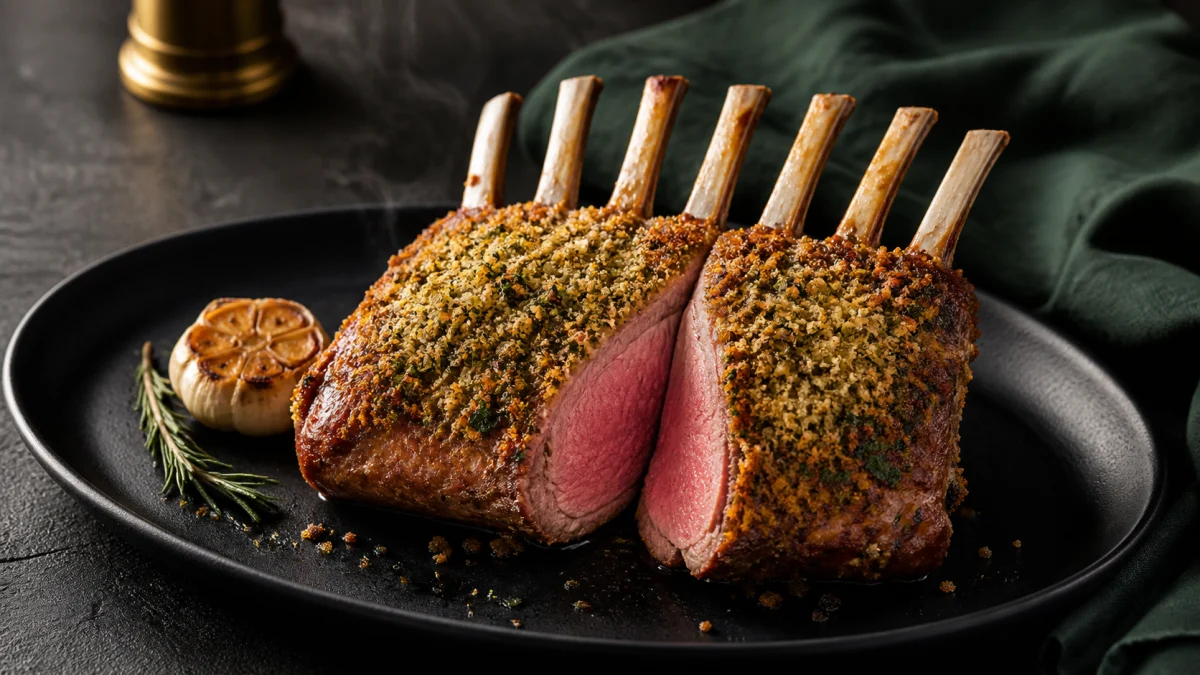
Few dishes deliver so much effect for so little work. A rack of lamb arrives whole at the table, herb crust golden, bones neatly aligned, and gets carved cutlet by cutlet in front of your guests. Twenty minutes in the oven, ten minutes resting: that is the whole of it.
The only real risk is overcooking. A rack taken too far turns dry and loses exactly what you paid for. Here is the complete method — from choosing the piece to carving it — with the internal temperatures that take the guesswork out.
Choosing your rack: what matters
Allow 3 to 4 cutlets per person as a main course. A full 14 to 16 bone rack — that is two racks of 7 to 8 — comfortably feeds four, or six if the meal includes a starter and proper side dishes.
Ask for it French-trimmed. French-trimming means clearing the meat and fat from the tips of the bones to give you those clean handles that make the presentation. It is butcher's work, not home-cook's work: simply ask for it when you order.
Do not have all the fat removed. The fat cap protects the meat and renders in the oven, basting it from the outside in. Three to five millimetres is the sweet spot: enough to nourish, not enough to be heavy. Fat that is firm and white is also the clearest sign of a well-raised, well-stored lamb.
The ingredients (for 4)
- 2 racks of lamb, 7 to 8 cutlets each (about 1.7 kg in total), French-trimmed
- 2 tbsp Dijon mustard — this is what glues the crust on
- 60 g breadcrumbs (day-old bread, blitzed, is best)
- 30 g flat-leaf parsley, finely chopped
- 2 garlic cloves, chopped
- 30 g melted butter
- 1 sprig of rosemary or thyme, leaves picked
- Olive oil, salt, black pepper
The method, step by step
- Temper and preheat. Take the racks out of the fridge 45 minutes ahead. Preheat the oven to 200 °C (180 °C fan). A rack that is cold in the centre cooks unevenly: the outside dries out before the middle turns pink.
- Prepare the meat. Pat it dry, then score the fat cap in a criss-cross pattern with the tip of a knife — shallow cuts that do not reach the meat. The fat renders better and the crust grips. Season all over with salt and pepper.
- Sear. In a properly hot pan with a little olive oil, lay the racks fat-side down for 3 minutes, until golden and rendered. Then 1 minute on each of the other sides. This step is not optional: it gives the colour, and it shortens the time in the oven.
- The herb crust. Mix breadcrumbs, parsley, garlic, herbs and melted butter until it has the texture of damp sand. It should hold together when pressed between your fingers without turning to paste.
- Coat. Brush the fat side of each rack with a thin layer of mustard, then press the crust mixture on firmly and evenly. Wrap the bone tips in a little foil if you want them spotless.
- Roast. Roast bones facing up — leaned against each other if you want the classic guard-of-honour presentation. Begin checking after 18 minutes. A pink result is often reached at around 18 to 22 minutes depending on thickness, but this culinary preference may remain below the official 63 °C minimum. To follow the MFSA reference, continue until the thickest part reaches at least 63 °C at the centre, keeping the probe away from the bone.
- Rest and carve. Rest for 10 minutes on a board, with a sheet of foil laid over the top but not tucked in. Then carve between the bones, decisively, in one stroke.
Internal temperatures
The minutes below assume a 7 to 8 bone rack that has been seared first. But thickness varies from piece to piece, and your oven is not ours: a probe thermometer is the only real judge. The temperature climbs another 2 to 3 °C while the meat rests.
| Culinary preference | Indicative time (200 °C) | Reference at removal | After resting | MFSA minimum |
|---|---|---|---|---|
| Rare | 14-16 min | 50 °C | 52-53 °C | Below the official minimum |
| Pink (the classic) | 18-22 min | 54 °C | 56-57 °C | Below the official minimum |
| Medium | 24-27 min | 60 °C | 62-63 °C | Removed below the official minimum |
| Well done | 30-34 min | 66 °C | 68-69 °C | Above the official minimum |
As a culinary preference, pink keeps this cut juicy and lets the lamb flavour come through without turning strong. It nevertheless remains below the official minimum of 63 °C at the centre; the table describes culinary references, not a food-safety validation.
Estimate the cooking time for your rack of lamb from its weight and oven method.
What to serve with it
A rack of lamb does not compete well: two well-made sides beat four. A potato gratin remains the undisputed classic, made ahead and reheated while the meat rests. Vegetables roasted in the same tray — sweet potato, carrot, onion — soak up the juices as they fall.
In Mauritius, lamb also takes very happily to a local side: a pumpkin purée, brèdes sautéed with garlic, or simply saffron rice. And for the sauce, there is no need to complicate things: deglaze the searing pan with a splash of water or stock, scrape up the browned bits, reduce for two minutes.
The mistakes to avoid
- Roasting without searing. The rack comes out pale and the crust will not grip. Three minutes fat-side down changes everything.
- Opening the oven to check. Every opening drops the temperature and stretches the cooking time. A leave-in probe, or a single check at 16 minutes, is enough.
- Putting the probe against the bone. Bone conducts heat and reads hotter than the meat. Aim for the centre of the eye, halfway through the thickness.
- Covering tightly while resting. Trapped steam softens the herb crust. Lay the foil on, do not wrap.
- Skipping the rest. Carving straight out of the oven drains the juices. Ten minutes is also exactly the time it takes to finish the sides.
The starting point: good lamb
On a cut this quick to cook, the quality of the meat cannot be corrected — you taste it directly. That is what you can order through Bon Manzé Maurice, delivered anywhere on the island:
- Aveyron lamb rack, 14 to 16 bones — Rs 3,400/kg, VAT included, per kilo weighed.
- French-trimmed on request: say so on WhatsApp and it is noted.
- The rest of the lamb range: bone-in leg from Rs 2,750/kg, boneless leg Rs 2,850/kg, loin Rs 4,000/kg, rump Rs 3,000/kg.
- Halal per supplier, delivered vacuum-sealed with the cold chain respected. Price confirmed at weighing, before delivery.
Free delivery from Rs 1,500 · payment on delivery (cash or Juice MCB) · nothing is paid online.
A rack of lamb for your recipe
Find the rack in the lamb selection, with its price and size. Tell us your guest count; confirm the weight, number of ribs and French trimming on WhatsApp.
Frequently asked questions
How long do you roast a rack of lamb?
Begin checking after 18 minutes at 200 °C for a 7 to 8 bone rack that has been seared first. The exact time depends on thickness and the oven. To follow the MFSA official minimum, wait until the thickest part reaches at least 63 °C at the centre, then rest it for at least 3 minutes. A pinker result is a culinary preference below that official threshold.
How many lamb cutlets per person?
Three to four cutlets per person as a main course. A full 14 to 16 bone rack comfortably feeds four, or six if the meal includes a starter and several side dishes. Our quantities guide covers the rest of the range.
Should you sear a rack of lamb before roasting?
Yes. Three minutes fat-side down in a properly hot pan renders some of the fat and builds a golden crust the oven alone will not give you. It also helps the rack cook evenly and makes the internal temperature easier to control.
Should you cover a rack of lamb while it rests?
Lay a sheet of foil over it without wrapping it, for 10 minutes. Sealing it tightly traps steam and softens the herb crust.
Can you prepare a rack of lamb ahead?
Partly. The herb crust can be made the day before and kept chilled. The racks can be trimmed, scored and seasoned a few hours ahead. The searing and roasting, though, happen at the last minute: it is a short cook, and it does not reheat well.
Which rack of lamb should you buy in Mauritius?
A French-trimmed rack with firm, white fat. At Bon Manzé Maurice, Aveyron lamb rack, given to us as halal by our supplier partner, is Rs 3,400/kg, VAT included, per kilo weighed and confirmed at weighing, in 14 to 16 bone pieces delivered vacuum-sealed.