 Bon Manzé
 How to cook a ribeye like a steakhouse
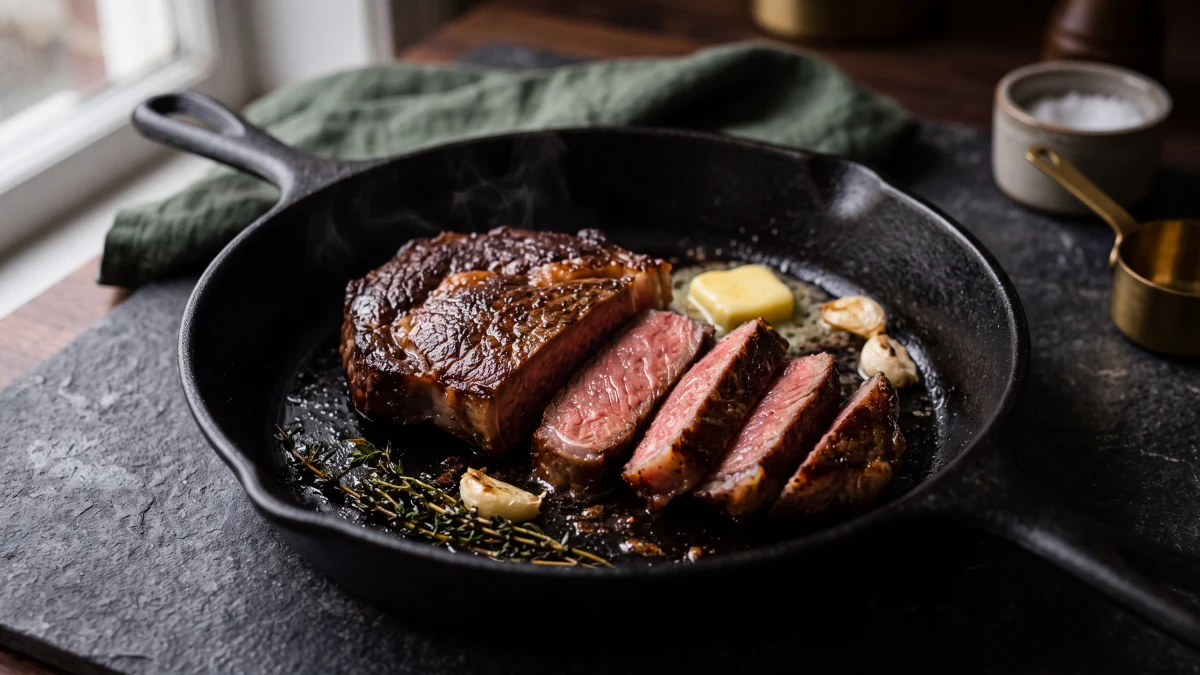
You know the feeling: at a restaurant, the ribeye arrives with a deep brown, crackling crust, a rosy glistening centre, and juices that stay in the meat rather than flooding the plate. At home, the same cut too often comes out grey, a little dry, and short on flavour.
The good news is that this has nothing to do with talent or professional equipment. Steakhouses follow four or five simple rules, every single time. Here they are, from the thickness of the cut all the way to the resting time.
Before any cooking: the cut decides everything
Thickness is the single biggest factor. A ribeye under 2 cm is lost before it starts: by the time the surface browns, the centre is already cooked through. That is simple physics, and no technique can rescue it. Aim for 3 cm minimum, which means a steak of 350 to 450 g. One generous thick ribeye shared between two people gives a far better result than two thin slices.
Marbling does the rest. Those fine veins of fat inside the muscle melt during cooking and baste the meat from within. That is what makes ribeye more forgiving than fillet: even slightly overcooked, it stays tender. And do not trim the fat cap around the edge before cooking — it protects the steak and gets seared separately (see step 5).
The ingredients (serves 2)
- 1 ribeye steak, 3 cm thick (about 400 g)
- Sea salt
- Freshly ground black pepper
- 1 tbsp neutral oil with a high smoke point
- 30 g butter
- 2 garlic cloves, crushed
- 1 sprig of thyme or rosemary
The method, step by step (pan)
- Temper, 45 minutes ahead. Take the meat out of the fridge and let it come up to room temperature, loosely covered. A steak that is ice-cold in the middle forces you to cook it longer, which overcooks the outside. In Mauritius, where the kitchen is already warm, 30 to 45 minutes is plenty.
- Dry, then salt. Pat both sides dry with kitchen paper: surface moisture turns to steam, and steam prevents a crust. Salt generously just before the meat goes into the pan. Pepper goes on after cooking — it burns and turns bitter over high heat.
- Get it properly hot. Cast iron or heavy steel, over high heat, until it just begins to smoke. Then a film of neutral, high-smoke-point oil. No butter at this stage: it would blacken before the meat had browned.
- Sear and leave it alone. Lay the ribeye down and do not touch it for 2 to 3 minutes. Do not move it, do not press it with a spatula — it is the uninterrupted contact that builds the crust. Turn it once, and repeat on the other side.
- Sear the fat cap. Hold the steak upright on its fat edge with tongs for 30 to 60 seconds. That fat renders, colours, and releases the grilled aroma that says steakhouse. It is the step almost everyone skips.
- Butter baste. Turn the heat down to medium, add a knob of butter, two crushed garlic cloves and a sprig of thyme. Tilt the pan and spoon the foaming, garlicky butter over the meat for 1 to 2 minutes. This is where the restaurant flavour comes from.
- Rest for 8 minutes. On a rack or an upturned plate, not tightly covered (that softens the crust). The fibres relax and the juices redistribute. Then slice against the grain, on a slight angle, and add the pepper.
Internal temperatures: the only reliable guide
Cooking times depend on too many variables — thickness, starting temperature, how powerful your hob is. A probe thermometer lets you check the temperature precisely. The table below gives culinary doneness references; they are distinct from the official food-safety threshold.
| Doneness | Pull from the pan | On the plate |
|---|---|---|
| Rare | 48 °C | 50-51 °C |
| Medium-rare | 52 °C | 54-55 °C |
| Medium | 56 °C | 58-59 °C |
| Well done | 62 °C | 64-65 °C |
Temperatures from 52 to 56 °C are culinary references, not safety thresholds. To follow the official guidance in Mauritius, reach at least 63 °C internally and rest for at least 3 minutes. To adapt the guidance to your steak's thickness, use our pan-seared ribeye cooking calculator.
Over coals, in Mauritius
The principle is the same, with one refinement: build two zones. One side with the coals banked, fiercely hot, for searing; one side with no coals, to finish gently with the lid down if your barbecue has one. Sear 2 minutes a side over the hot zone, then move the steak to the cool zone until it reaches temperature.
Wait until the coals are covered in grey ash before putting anything on: open flames do not cook, they char. If dripping fat flares up, simply move the meat aside until it settles. For the rest of the meal — quantities, marinades, other cuts worth grilling — our barbecue in Mauritius guide covers it all.
The mistakes that cost you a ribeye
- A pan that is not hot enough. The meat stews instead of searing, releases its water and turns grey. If you do not hear a sharp sizzle the second the steak lands, take it out and wait.
- Too much meat at once. Two ribeyes in a small pan crash the temperature. Cook them one after the other: the first rests while the second sears.
- Salting 10 minutes ahead. That is the worst possible moment: the salt has beaded moisture on the surface without having had time to be reabsorbed. Salt just before, or 40 minutes before.
- Slicing straight away. The juices run onto the plate instead of staying in the meat. Eight minutes of patience is worth all the rest of the technique.
- A steak that is too thin. No method saves a 1.5 cm ribeye. It is the cut, not the cooking, that decides.
The starting point: a good piece of beef
All this technique exists only to reveal what is already in the meat. Well-raised, well-marbled beef cut to the right thickness does half the work — which is part of why the restaurant result feels out of reach at home.
That is what Bon Manzé Maurice delivers to your door, anywhere on the island:
- Black Angus ribeye from Argentina, grass-fed — Rs 3,400/kg, VAT included, per kilo weighed.
- Cut to the thickness you ask for: say « 3 cm » on WhatsApp and it is noted.
- Angus côte de bœuf for a big table, bavette from Rs 2,650/kg and fillet for those who prefer a leaner cut.
- Kobe beef A5 ribeye, certified by the Japan Halal Association — price on request, for an occasion that deserves it.
- 100% halal, delivered vacuum-sealed with the cold chain respected. Price confirmed at weighing, before delivery.
Free delivery from Rs 1,500 · payment on delivery (cash or Juice MCB) · nothing is paid online.
Your next ribeye, cut at 3 cm
Tell us how many people you are feeding and the date of your meal — we confirm the available thickness and a suitable delivery window.
In WhatsApp, tap Send to submit your request. Availability, total and delivery window are confirmed with you before you place an order.
Frequently asked questions
How thick should a ribeye steak be?
At least 3 cm, which is roughly 350 to 450 g. Under 2 cm the centre is cooked through before a crust has formed, so you end up with a grey, dry steak. One thick ribeye shared between two people always beats two thin ones.
Should you salt a ribeye before or after cooking?
Salt right before searing, or at least 40 minutes ahead. In between, the salt has drawn moisture to the surface without having had time to be reabsorbed, which stops the crust from forming.
What internal temperature for a medium-rare ribeye?
Pulling a ribeye at 52 °C is a common culinary reference for medium-rare, but it is not the official food-safety threshold. In Mauritius, the MFSA recommends at least 63 °C internally for whole steaks and roasts, followed by a rest of at least 3 minutes. Read the official MFSA guidance.
How long should a ribeye rest?
About 8 minutes for a 3 cm steak, on a rack and not tightly covered. Resting lets the fibres relax and the juices redistribute: slicing straight away empties the meat onto the plate.
Can you cook a ribeye without a thermometer?
Yes, but it is less reliable. For a tempered 3 cm steak, allow around 3 minutes per side for medium-rare, then 1 to 2 minutes of butter basting. The finger test (gently springy at medium-rare, firm at medium) comes with practice.
Which ribeye should you buy in Mauritius?
A well-marbled steak, cut thick. At Bon Manzé Maurice, grass-fed Argentinian Black Angus ribeye is Rs 3,400/kg, VAT included, per kilo weighed and confirmed at weighing, with the requested steak thickness to confirm and delivered vacuum-sealed.