 Bon Manzé
 Kobe Beef in Mauritius: How to Spot the Real Thing
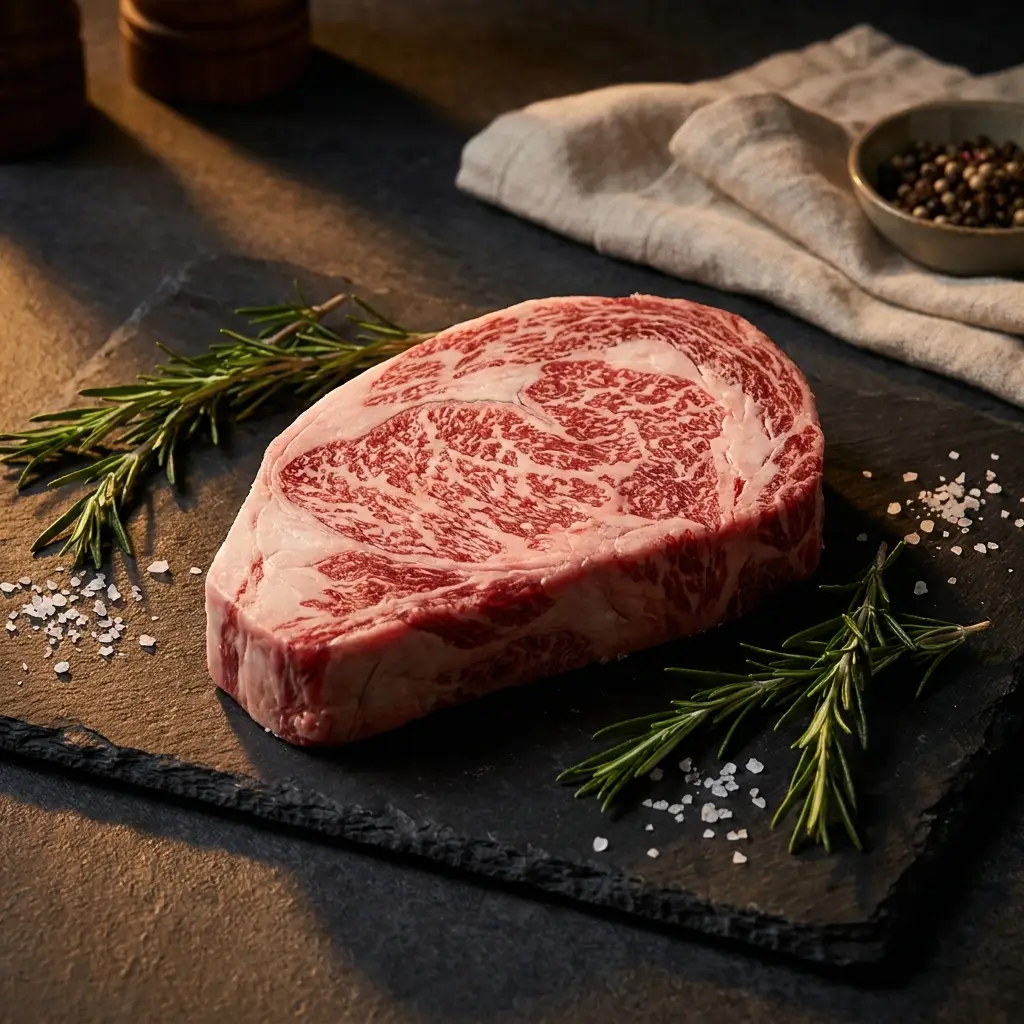
Kobe beef is considered one of the most prestigious in the world: spectacular marbling, a melt-in-the-mouth tenderness, a flavour like nothing else. The catch? The word 'Kobe' — like 'wagyu' — gets used just about everywhere, and most of what's sold under that name isn't real Kobe.
This guide gives you the simple markers: what separates wagyu from Kobe, what makes a Kobe genuine, marbling explained in plain terms, and what our supplier partner tells us about it, delivered to your door in Mauritius.
'Wagyu', 'Kobe', 'Kobe-style': the difference that changes everything
Wagyu, literally 'Japanese beef', refers to a group of Japanese cattle breeds. It's a broad family — and not all wagyu is equal.
Kobe, on the other hand, is an extremely strict designation. To carry the name, a cut must come from Tajima-lineage cattle, born, raised and slaughtered in Hyōgo Prefecture, Japan, and meet precise criteria for marbling, weight and quality. Every approved carcass is given a traceable identification number. In other words: all Kobe is wagyu, but only a tiny fraction of wagyu is Kobe.
'Kobe-style', 'Kobe-inspired', 'local wagyu': these labels most often mean a crossbreed raised somewhere other than Hyōgo. It can be good meat — but it isn't Kobe, and it shouldn't claim to be.
The 4 proofs of real Kobe
- The certificate of authenticity + the identification number. Real Kobe is traced and numbered piece by piece, from Japan to the plate.
- The origin: Hyōgo, Japan. Not 'Japan' in general, not 'Asia' — Hyōgo Prefecture, specifically.
- The official quality criteria. The carcass must notably reach meat quality grade 4 or 5 and BMS 6 or higher; our selection goes further at A5 BMS 10/12.
- Visible marbling. Fine, dense, even marbling in a pearly white that runs right through the meat — not a few big, isolated streaks of fat.
You can read the official Kobe Beef association criteria.
Marbling (BMS) explained simply
The BMS (Beef Marbling Standard) rates marbling on a scale of 1 to 12. The higher the number, the more the fat is intramuscular — meaning finely woven into the muscle rather than sitting around the edges. It's this fat that melts as it cooks, coats every fibre and gives that melt-in-the-mouth sensation.
An A5 BMS 10 to 12 sits at the very top of the scale: the letter A rates the yield, the number 5 the highest quality, and BMS 10-12 an exceptional marbling. This is exactly the level we are offered.
Halal and Kobe: yes, it's possible
Many people assume Kobe and halal can't go together. They're wrong. There is authentic Kobe slaughtered according to the rite and certified halal by a recognised body (the Japan Halal Association). It's rare, it's documented by certificate, and it proves that a religious requirement and the very finest quality are not mutually exclusive.
In Mauritius: where to find real Kobe
This is exactly why Bon Manzé Maurice offers genuine Kobe you can order with confidence:
- Authentic A5 BMS 10/12 Kobe, Hyōgo origin — backed by supplier certificates.
- All our meat is given to us as halal by our supplier partner.
- Vacuum-sealed, cold chain maintained all the way to your door, anywhere in Mauritius.
- Price on request, based on actual weight and including VAT. We send the available cuts, their exact weight and price before anything is confirmed.
- A real person on WhatsApp to guide you on quantity and cut.
Free delivery from Rs 1 500 · pay on delivery (cash or Juice MCB) · nothing is paid online · quantities strictly limited per batch.
How to cook it without ruining it
Kobe isn't handled like an ordinary steak — its richness in fat changes everything:
- Thin slices, seared over very high heat, just a few seconds per side.
- No added fat: it releases more than enough of its own.
- Salt right at the end of cooking, never before.
- Never past rare: overcook it and you lose everything that makes it special.
- Plan the quantity for your table: we advise you according to the number of guests, the style of meal and the cuts available.
Want to taste the real thing?
Receive the cuts currently available, their exact weight and price, then compose a selection for your table.
Frequently asked questions
What's the difference between wagyu and Kobe beef?
Wagyu refers to Japanese cattle breeds in general; Kobe is a strict designation reserved for Tajima beef born, raised and slaughtered in Hyōgo, certified piece by piece. All Kobe is wagyu, but very little wagyu is Kobe.
Is the Kobe sold in Mauritius always authentic?
No — a lot of meat is sold as 'Kobe' or 'Kobe-style' without being the real thing. What sets real Kobe apart: the certificate of authenticity and a Hyōgo origin. These rest with our supplier partner, who gives us the Hyōgo origin and the A5 BMS 10/12 grade.
Can Kobe beef be halal?
Yes — there is authentic Kobe slaughtered according to the rite and certified by the Japan Halal Association. It's rare and documented. The Kobe we pass on is given to us as halal by our supplier partner. We hold no certification.
How much does real Kobe cost in Mauritius?
The price is shared on request according to the batch, the cut and its exact weight. Before confirmation, we send the available cuts, weights and VAT-inclusive prices.
How do you cook it?
Even slices, very high heat, a few seconds per side, no added fat and salt at the end. We can also advise the quantity and preparation for your table.